
PhD research uncovers new cell population that may help lung cancer suppress the immune system
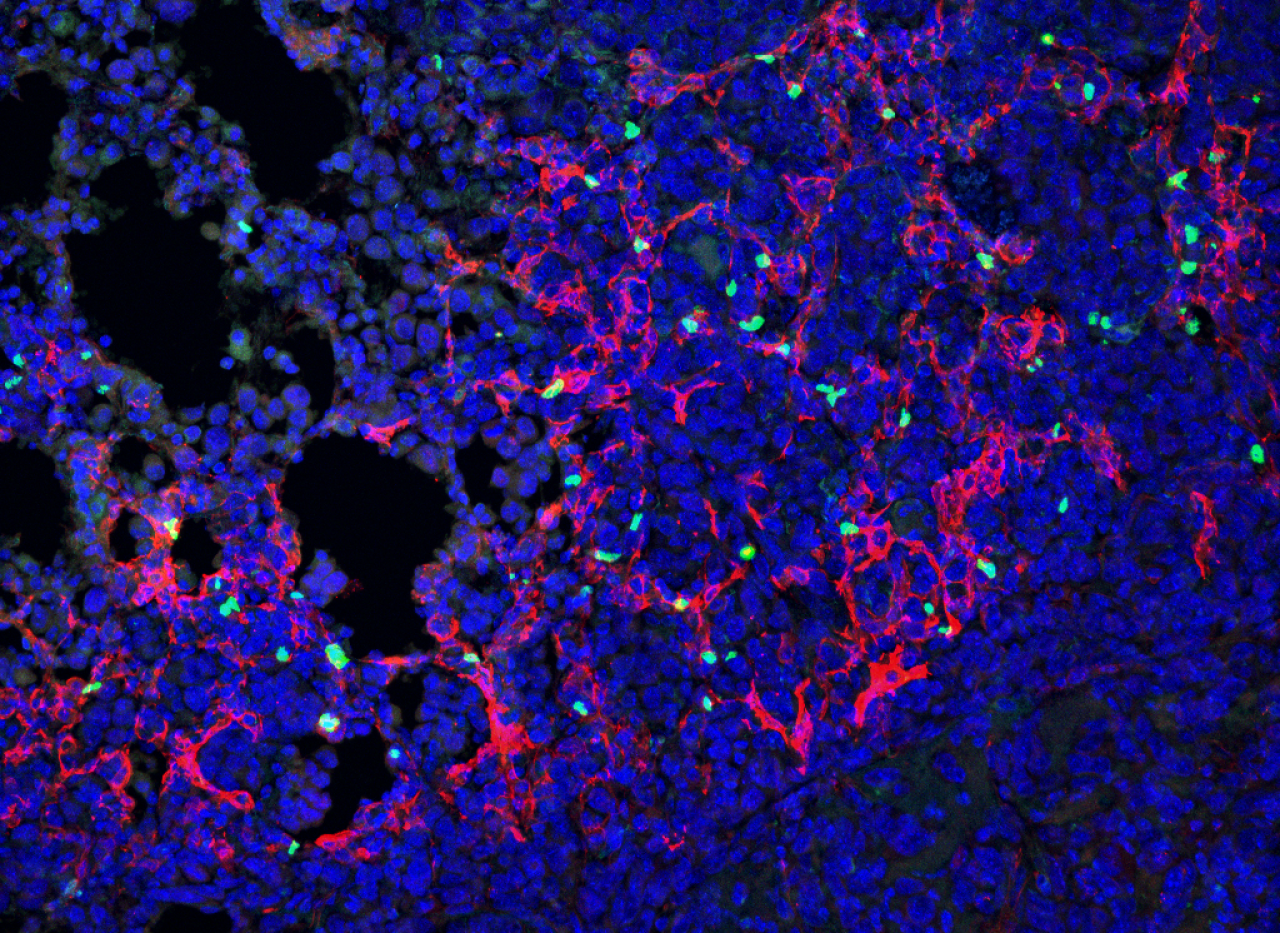
Fluorescence microscopy image from the study showing cells in lung tumour tissue. The research identified a previously unrecognised population of cancer-associated fibroblasts that may help create an immune-suppressive environment around lung tumours. Credit: Image courtesy of Olivia Ringham / Columbia University Vagelos College of Physicians and Surgeons.
Research led by PhD student Olivia Ringham has identified a previously unrecognised group of cells around lung tumours that may help cancer suppress the immune response.
The study, published in Nature Immunology, focused on lung adenocarcinoma, the most common type of non-small cell lung cancer (NSCLC).
Researchers found a distinct group of cells called cancer-associated fibroblasts. These cells appear to attract highly suppressive immune cells to the edge of lung tumours.
When the researchers disrupted this process in laboratory models, tumour burden fell and cancer-fighting immune activity increased. The team also found similar cells in human NSCLC samples.
What did the new lung cancer study find?
Fibroblasts are cells that normally help support and repair tissues.
Fibroblasts can also be found around cancers. These are known as cancer-associated fibroblasts, or CAFs. Different types of CAF can have different effects on a tumour.
Ringham and colleagues identified a previously unrecognised CAF population in lung cancer. The cells were marked by high levels of a protein called CHL1.
The researchers called them immunomodulatory cancer-associated fibroblasts, or imCAFs.
These cells were found mainly around the border of lung tumours.
How can these cells suppress the immune response to lung cancer?
The researchers found that the new fibroblasts produce a signalling protein called CXCL9.
CXCL9 attracts a type of immune cell called a regulatory T cell, or Treg cell.
Regulatory T cells normally help stop the immune system from becoming too active. But inside a tumour, some Treg cells can also reduce the immune system’s ability to attack cancer cells.
The Treg cells found around the lung tumours were particularly suppressive.
The researchers found that the CHL1-positive fibroblasts helped draw these cells towards the tumour border. This created an environment where anti-cancer immune responses were reduced.
What happened when researchers blocked the pathway?
The team tested what happened when parts of this signalling pathway were removed in mouse models of lung cancer.
When CXCR3, the receptor used by the regulatory T cells, was removed, fewer Treg cells accumulated in the tumours.
When CXCL9 produced by surrounding stromal cells was removed, the researchers also saw:
fewer regulatory T cells in the tumour
more activity from cancer-fighting CD8+ T cells
lower tumour burden
The findings suggest that this cell-to-cell signalling pathway helps lung tumours create a more suppressive immune environment.
Was the new cell population found in human lung cancer?
Yes.
The researchers analysed fibroblasts from 43 people across six studies included in a large NSCLC single-cell dataset.
They found a similar CHL1-positive fibroblast population in human lung tumours.
The team also examined human lung adenocarcinoma tissue and found that these fibroblasts were located close to regulatory T cells, similar to what they had seen in the laboratory models.
The researchers then looked at data from The Cancer Genome Atlas.
Higher CHL1 expression was associated with:
lower anti-cancer immune activity
more cancer-associated fibroblasts
shorter progression-free survival
This does not show that CHL1 itself causes poorer outcomes. It does support further research into this cell population and the immune environment around lung tumours.
Could this lead to a new lung cancer treatment?
There is no treatment from this research yet.
The study identifies a specific biological pathway that researchers could investigate as a treatment target.
One possibility would be to disrupt the interaction between the CHL1-positive fibroblasts and the highly suppressive regulatory T cells.
The researchers suggest that a more targeted approach could strengthen anti-cancer immunity without removing regulatory T cells throughout the body. These cells also perform important normal immune functions.
The authors also suggest that targeting this pathway could eventually be studied alongside existing immunotherapies, such as immune checkpoint inhibitors.
Who led the lung cancer research?
Olivia Ringham is first author of the study, which came from work completed during her PhD at Columbia University Irving Medical Center.
The research was carried out with Nicholas Arpaia and colleagues at Columbia University, with collaborators from the University of Toronto and other research teams.
The paper is titled:
“A novel CAF population coordinates hyper-suppressive regulatory T cell recruitment and localization in lung cancer.”
For Ringham, the publication marks the outcome of research completed during her PhD. She has described the work publicly as a collaboration involving a large team of researchers.
New lung cancer cell discovery: key points
Researchers identified a previously unrecognised fibroblast population around lung tumours.
The cells are marked by the protein CHL1.
They attract highly suppressive regulatory T cells towards the tumour.
Disrupting this pathway reduced tumour burden in mouse models.
Similar fibroblasts were found in human NSCLC.
Higher CHL1 expression was associated with shorter progression-free survival in human lung adenocarcinoma data.
The pathway is now a possible target for future lung cancer research.
Source: Ringham OR, Rivera M, Loffredo LF, et al. A novel CAF population coordinates hyper-suppressive regulatory T cell recruitment and localization in lung cancer. Nature Immunology. Published 11 August 2026. Read the open-access paper in Nature Immunology