
Patient-reported outcomes: asking people with lung cancer how they are
"How will my life be after this?" is one of the first questions people ask after a lung cancer diagnosis. Not survival curves, but daily life. Managing at work, sleeping through the night, walking the dog, being there for the people you love.
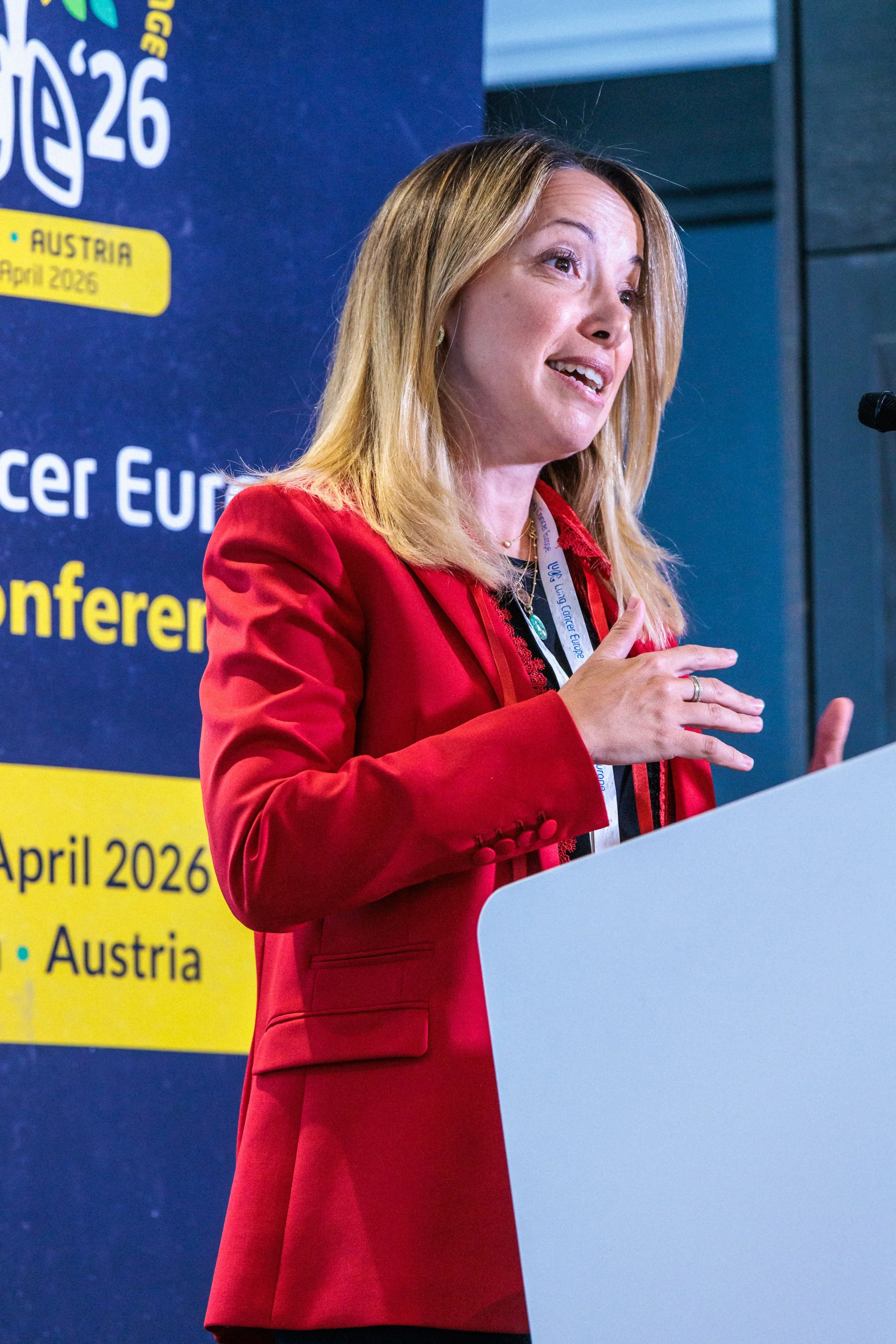
At our conference in Vienna this year, Cecilia Pompili made this point plainly. Pompili is an associate professor and thoracic surgeon at the University of Hull, and patient-reported outcomes have been the focus of her career. Clinicians, she argues, are the experts on the medical evidence, and the person is the expert on what counts most to them. For many people facing lung surgery, the biggest worry is whether they will get their normal life back, more than the operation itself.
That worry can be measured. What a person tells their care team about their symptoms and daily life is a patient-reported outcome, or PRO. The questionnaires that capture it are patient-reported outcome measures, or PROMs. The idea is straightforward. You ask the person how they feel, and you use the answer.
What PROMs measure
Lung cancer care runs on numbers: scan results, blood tests, how long people live. All of it is important. But those numbers do not show whether someone can breathe well enough to walk to the shops, whether a cough is keeping them awake, or whether treatment has left them too tired to work.
A PROM records that. A short set of questions, answered by the person, about their symptoms and daily life. Sometimes on paper. Increasingly online, so the care team can see changes week by week and step in early.
What people tell us they want
When Lung Cancer Europe asked people across Europe about their care, quality of life came through clearly. In our Empowering Voices survey, one in three people with lung cancer said they prioritise quality of life over length of life, and 64% valued both equally. Almost half were closely involved in decisions about their care, but only 56% felt heard. Among people with EGFR-mutant lung cancer, 90.9% said access to information was extremely important, and only 22.8% received all the information they needed.
Why asking gives clinical information
Research by Pompili and colleagues has shown that how someone rates their physical function and quality of life before lung surgery predicts how long they live afterwards, and how likely they are to have complications. Standard fitness checks, breathing tests and scans can miss this. The person's own report picks it up.
There is more evidence. In a large trial in the United States, people having treatment for advanced cancer were asked about their symptoms regularly, and the team acted on what they reported. That group lived about five months longer than the group getting usual care. The researcher who led it noted that many newly approved cancer drugs offer less benefit than that, at far greater cost.
A review published in 2025, the first to pool this evidence for lung cancer on its own, pointed the same way. Asking about symptoms and acting on them improved quality of life, and suggested a survival benefit too. The size of the effect needs care, because the studies were small and varied. The direction was consistent.
Do people want to fill in questionnaires?
There is a common worry that questionnaires are a burden, and that people would rather not complete them. When researchers have looked, most people value them. Filling in the questions gives people a way to raise things with their clinician that no one had asked about directly.
What still goes uncounted
Even where symptoms are recorded, a lot is left out.
Tolerability. Not the medical list of side effects, but what those side effects feel like to live with day to day. Someone might accept a rough few weeks over months of feeling slightly unwell, and only they can say so.
Time. The hours spent travelling to appointments, waiting, and recovering at home. This is sometimes called time toxicity, and it is rarely factored in.
Cost. The financial impact of a diagnosis, in lost earnings, travel and everything else. Lung Cancer Europe's report on financial toxicity set this out.
Women's experiences. More younger women are being diagnosed, often at an early stage, while working and caring for children. The thoracic oncologist Narjust Florez has pointed out that longer survival on targeted therapies has not been matched by attention to quality of life, from fertility and sexual health to caregiving, which often falls on younger women. In one review of lung surgery, women reported worse mental health afterwards, and fewer than half of the studies reported results separately for women.
Why lung cancer trials report quality of life less
If PROMs are useful, why are they not standard?
Lung cancer is one of the cancers least likely to report quality of life properly in its major trials. A 2025 study by Pompili, Florez and colleagues looked at 25 trials of targeted therapies and immunotherapy in early-stage lung cancer, where the aim of treatment is cure. Almost half, 48%, did not measure quality of life at all. Of the trials with full results available, only 14% reported their quality of life findings. Where it is included, it often sits in an appendix rather than the main paper.
The same pattern shows up in individual trials. ASTRUM-005, a large first-line trial in extensive-stage small cell lung cancer, reported its survival benefit in 2022 but did not present its patient-reported outcomes until 2024, with the peer-reviewed publication following in 2026. The quality of life data arrived years after the headline.
The direction of travel
Attention across Europe is turning to how care records what people with lung cancer actually experience. Work is under way to agree shared ways to measure quality of life across many European countries, including the EUonQoL project, which covers EU member states and associated countries including the UK and is due to report at the end of 2026. The aim is to make asking, and acting on the answer, a normal part of care rather than an extra.
Counting what people tell us
As our President Debra Montague puts it, our reports are "the patient voice, quantified and heard."
The person with lung cancer knows how they feel and what they want from their care. Recording that, and acting on it, is part of good treatment. The next step is to make it routine.
Sources and further reading
Cecilia Pompili, presentation at the Lung Cancer Europe Conference, Vienna, 2026.Pompili C, Salati M, Refai M, et al. Preoperative quality of life predicts survival following pulmonary resection in stage I non-small-cell lung cancer. European Journal of Cardio-Thoracic Surgery. 2013;43(5):905-910. Salomone F, Novero G, Ciani O, Ferrara R, Servetto A, Florez N, Di Maio M, Pravettoni G, Pompili C. Health-related quality of life assessment in trials testing tyrosine kinase inhibitors or immune checkpoint inhibitors in early-stage NSCLC. The Oncologist. 2025;30(10):oyaf339. Basch E, Deal AM, Dueck AC, et al. Overall survival results of a trial assessing patient-reported outcomes for symptom monitoring during routine cancer treatment. JAMA. 2017;318(2):197-198. Xia Y, Guan X, Zhu W, Wang Y, Shi Z, He P. Effectiveness of symptom monitoring on electronic patient-reported outcomes (ePROs) among patients with lung cancer: a systematic review and meta-analysis. npj Digital Medicine. 2025;8.Lung Cancer Europe, Empowering Voices: Knowledge and decision-making among people impacted by lung cancer in Europe, November 2024, and the oncogene-driven report, May 2025.Cheng Y, et al. ASTRUM-005 extended follow-up and patient-reported outcomes. J Clin Oncol. 2024;42(suppl 16):8100. Final analysis published in JAMA Oncology, June 2026, with an accompanying editor's note by Narjust Florez, doi: 10.1001/jamaoncol.2026.1374. EUonQoL project