
A lung cancer diagnosis brings physical and emotional challenges. For many people, it also brings serious money worries.
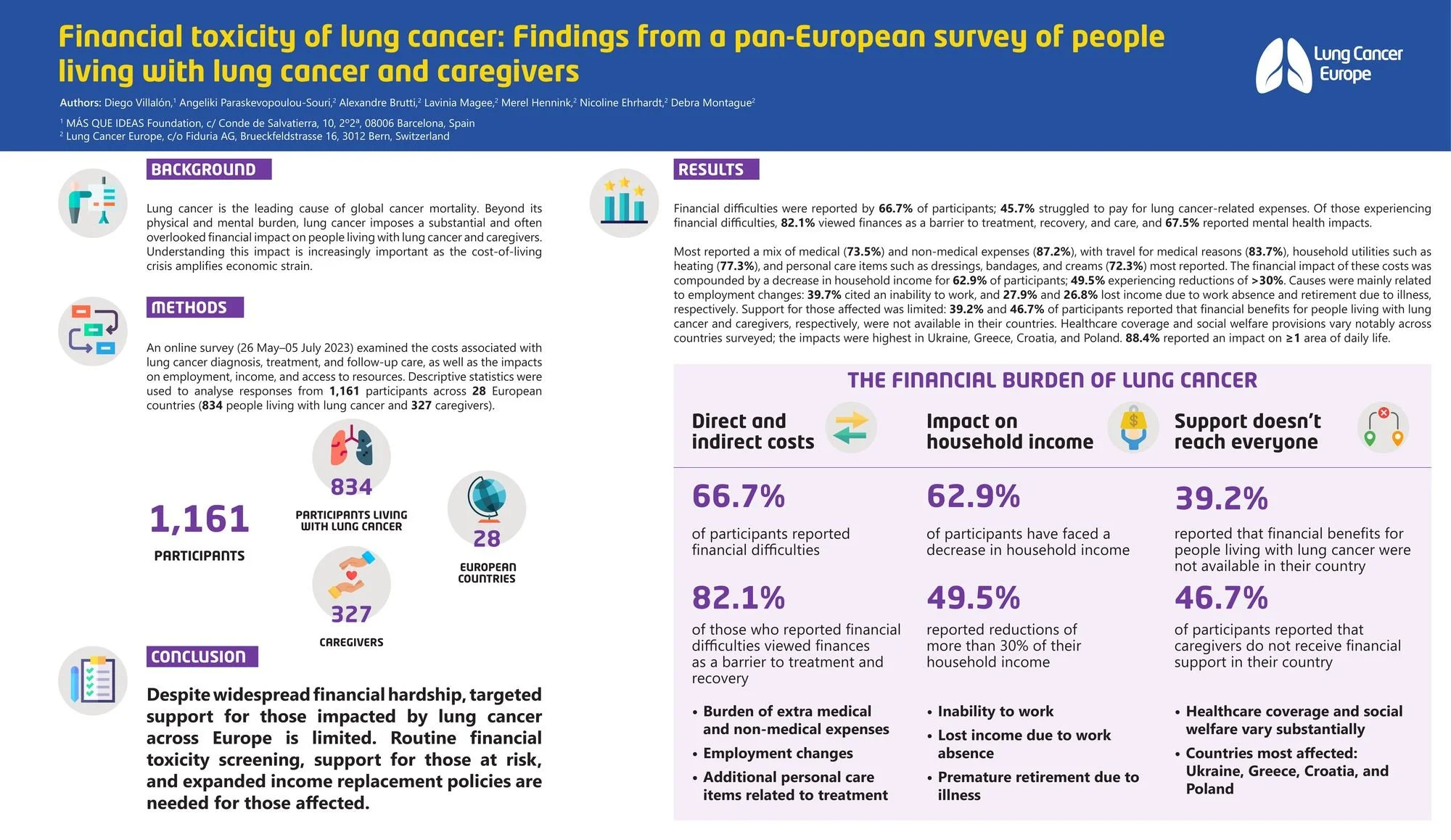
At the ESMO Congress 2026 in Madrid, Lung Cancer Europe President Debra Montague is presenting our research on the financial toxicity of lung cancer. The poster draws on a survey of 1,161 people from 28 European countries, including 834 people living with lung cancer and 327 caregivers.
The findings show that financial hardship is widespread, that it can stand in the way of treatment and recovery, and that support varies hugely depending on where you live.
What is financial toxicity?
Financial toxicity describes the financial burden of cancer and its treatment, and the stress that comes with it. It covers direct costs, such as medicines and travel to appointments, and indirect costs, such as lost income when someone can no longer work.
With the cost of living rising across Europe, understanding this burden is more urgent than ever.
Two in three people affected by lung cancer face financial difficulties
Of everyone who took part in the survey:
66.7% reported financial difficulties
45.7% struggled to pay for lung cancer-related expenses
Among those facing financial difficulties:
82.1% said money was a barrier to treatment, recovery and care
67.5% said it affected their mental health
Overall, 88.4% reported an impact on at least one area of their daily life.
The hidden costs of lung cancer
Most people faced a mix of medical costs (73.5%) and non-medical costs (87.2%). The most common expenses were:
Travel for medical reasons (83.7%)
Household bills such as heating (77.3%)
Personal care items such as dressings, bandages and creams (72.3%)
Many of these costs are easy to overlook, but they add up quickly over months or years of treatment and follow-up care.
How lung cancer affects household income
Rising costs often came at the same time as falling income. 62.9% of participants saw their household income drop, and for 49.5% it fell by more than 30%.
The main reasons were linked to work:
39.7% were unable to work
27.9% lost income because of time off work
26.8% retired early because of illness
Financial support for people with lung cancer and caregivers varies across Europe
Help is not reaching everyone who needs it. 39.2% of participants said financial benefits for people living with lung cancer were not available in their country, and 46.7% said caregivers receive no financial support.
Healthcare coverage and social welfare differ widely between countries. The financial impact was highest in Ukraine, Greece, Croatia and Poland.
What needs to change
Despite widespread financial hardship, targeted support for people affected by lung cancer across Europe is limited. Lung Cancer Europe is calling for:
Routine financial toxicity screening, so healthcare teams can spot financial problems early
Support for those most at risk, including practical and financial help during treatment
Expanded income replacement policies for people living with lung cancer and the people who care for them
New treatments are improving outcomes for many people with lung cancer. Those advances only help if people can afford to access them and stay on them.
Faster access to innovation must reach everyone
This links directly to Lung Cancer Europe's position on the proposed EU Biotech Act. We welcome the Act's aim of making health biotechnology in Europe faster and more competitive. But faster development will only help people with lung cancer if new treatments and tests reach them in every member state.
When two in three people affected by lung cancer are already struggling financially, and support depends on where they live, access is about more than approval timelines. Travel to specialist centres, time off work and the everyday costs of treatment can all stand between a person and the care they need. Tackling financial toxicity has to be part of making innovation work for everyone.
Read the poster and the full report
Click the poster to view it in full.
The complete survey findings are in the 8th Lung Cancer Europe Report, Financial impact of lung cancer: A European perspective.