
Full results from the phase 3 DeLLphi-305 trial, presented at the ESMO Congress 2026 Presidential Symposium in Madrid, show that adding tarlatamab to durvalumab maintenance treatment extended survival for people with extensive-stage small cell lung cancer whose disease had not progressed after initial chemo-immunotherapy.
What is DeLLphi-305?
DeLLphi-305 (NCT06211036) is a global phase 3 trial in 563 people with extensive-stage small cell lung cancer (ES-SCLC). Everyone in the trial had already had first-line treatment with durvalumab, platinum chemotherapy and etoposide, and their disease had not progressed. From that point, people were given one of two maintenance treatments: durvalumab plus tarlatamab, or durvalumab alone.
Durvalumab (Imfinzi) is an immunotherapy already used as part of first-line treatment for ES-SCLC in Europe and the UK. Tarlatamab (Imdelltra) works differently. It is a bispecific antibody with two arms: one binds to CD3 on T cells, and the other binds to DLL3, a protein found on most small cell lung cancer cells. This brings the T cell and the tumour cell together and switches the T cell on to attack the cancer cell. Tarlatamab is already approved in the EU and UK for people whose small cell lung cancer has come back after earlier treatment. DeLLphi-305 tested what happens when tarlatamab is used earlier, straight after first-line treatment, instead of waiting for the cancer to return.
The diagram below shows how the two drugs work together: tarlatamab bridges the T cell and the tumour cell, while durvalumab stops the tumour cell from switching the T cell's attack back off.
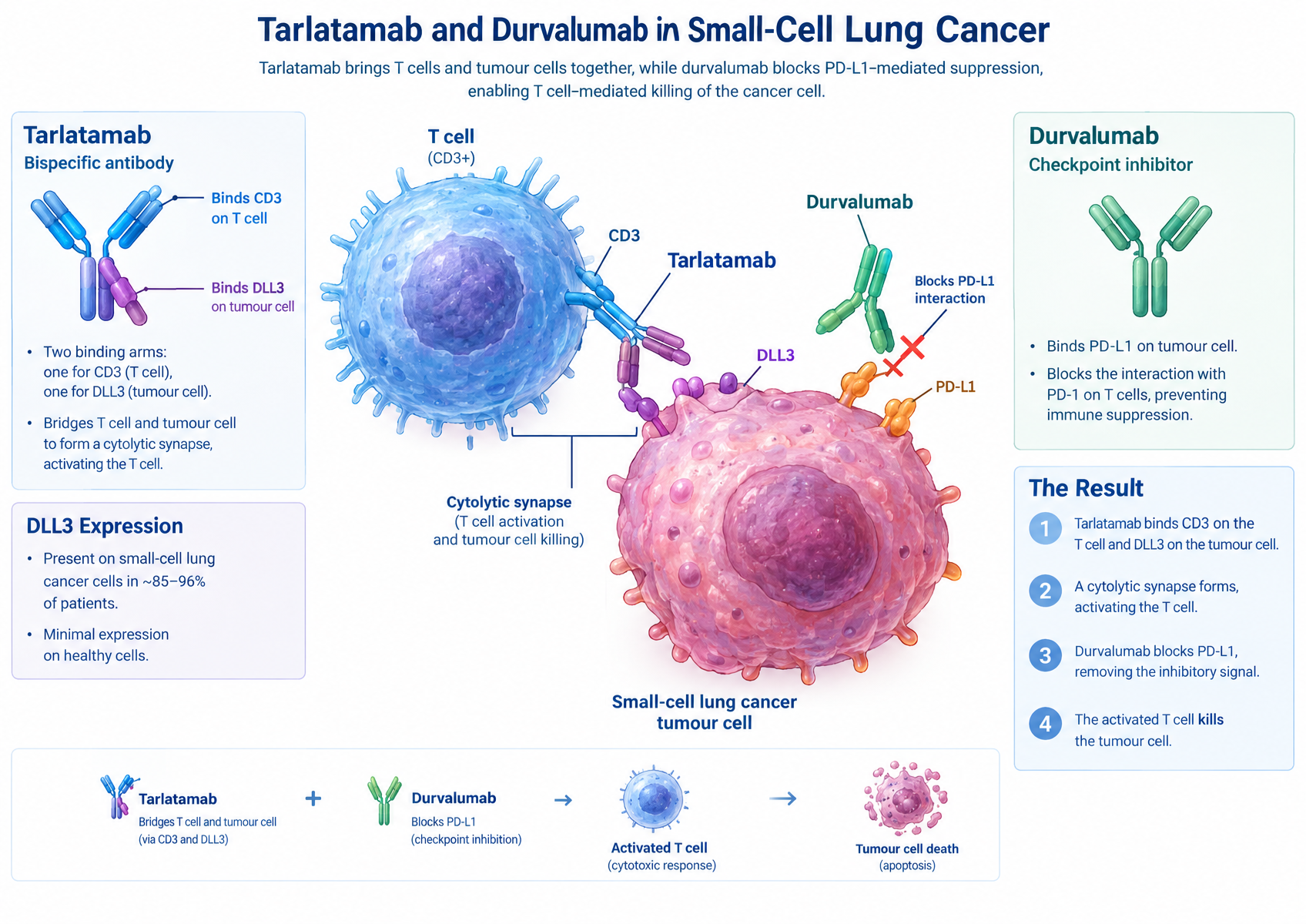
How tarlatamab and durvalumab work together. Tarlatamab binds CD3 on the T cell and DLL3 on the tumour cell, forming a cytolytic synapse that activates the T cell. Durvalumab binds PD-L1 on the tumour cell, blocking the signal it would otherwise use to switch the T cell's attack off. Diagram created for Lung Cancer Europe using Illustrae.
The trial included people with treated and untreated brain metastases that were not causing symptoms, a group often left out of trials but common in extensive-stage small cell lung cancer.
The results
563 people were randomly assigned to the combination (282 people) or to durvalumab alone (281 people). After a median follow-up of around 16 months in both groups, the combination improved survival, time without the cancer progressing, and the chance of the tumour shrinking:
Median overall survival was 21.1 months with the combination, compared with 12.7 months with durvalumab alone (hazard ratio 0.42, 95% confidence interval 0.32 to 0.54, P<0.001). A hazard ratio of 0.42 means the risk of death at any given point was reduced by 58% with the combination.
79.4% of people on the combination were alive at 12 months, compared with 53.3% on durvalumab alone.
Median progression-free survival was 7.4 months with the combination, compared with 1.9 months with durvalumab alone (hazard ratio 0.34, P<0.001).
The tumour shrank in 26.4% of people on the combination, compared with 4.1% on durvalumab alone (P<0.001).
These figures build on the headline result Amgen and AstraZeneca announced in September 2026, when the trial met its main goal of improving overall survival, without giving exact numbers at that stage. The full data presented at ESMO now gives the detail behind that announcement.
Safety
Treatment-related side effects graded 3 or 4 happened in 20.9% of people on the combination, compared with 10.8% on durvalumab alone, according to AstraZeneca's results release and the simultaneous New England Journal of Medicine publication.
Cytokine release syndrome, a known effect of T-cell engager treatments like tarlatamab, happened in 49.6% of people on the combination, compared with 1.4% on durvalumab alone. Most cases were low grade, with cytokine release syndrome graded 3 or higher in only 0.4% of people. A related effect called immune effector cell-associated neurotoxicity syndrome happened in 1.1% of people on the combination, with no cases graded 3 or higher. There were no deaths from either side effect in the trial.
Because of the cytokine release syndrome risk, people starting tarlatamab are monitored in a healthcare setting for one to two hours after their first two infusions. In some regions, including Europe, this monitoring period is six to eight hours. This affects how and where treatment needs to be delivered.
No new or unexpected safety problems were seen with the combination beyond what is already known about each drug individually.
What this means for people in Europe
Both drugs are already used in Europe and the UK: durvalumab in first-line treatment, and tarlatamab once the cancer has come back. DeLLphi-305 tested combining them earlier, straight after first-line treatment, instead of waiting for relapse to introduce tarlatamab.
This is conference data, not a regulatory approval. Any change to standard treatment in Europe will need to go through the European Medicines Agency and then national health technology assessment, which takes time and works differently in each country.
Doctors will also want to see how this combination compares with maintenance lurbinectedin (Zepzelca), another option used in this setting. DeLLphi-305 did not test the two directly against each other, so that comparison will come from looking at the two trials side by side rather than from a single trial.
Sources: Sands J, et al. "Tarlatamab-Durvalumab Maintenance for Extensive-Stage Small-Cell Lung Cancer (DeLLphi-305)." New England Journal of Medicine, 24 October 2026 https://www.nejm.org/doi/full/10.1056/NEJMoa2609482