
Fast diagnosis, fragmented support: watch our small cell lung cancer webinar
Small cell lung cancer can move quickly. Diagnosis, tests and treatment decisions may all happen within a very short time. But information, support and access to treatment do not always move as quickly.
On 3 September 2026, Lung Cancer Europe brought together people with clinical, research and lived experience of small cell lung cancer to discuss what is changing, where the gaps remain and what needs to improve across Europe.
Watch the webinar
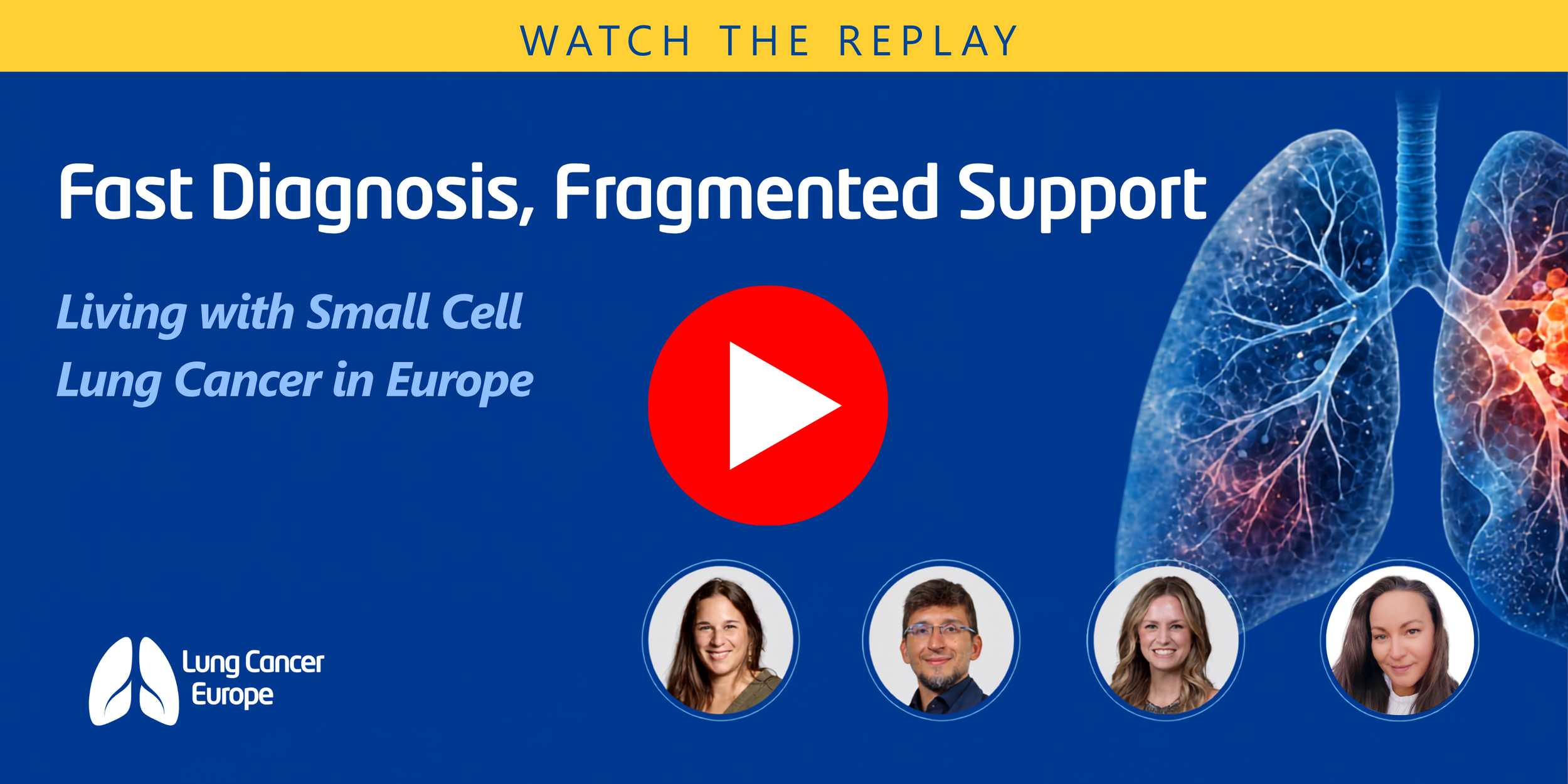
The discussion covered:
delays in diagnosis and treatment
communication and shared decision-making
access to clinical trials and new treatments
the growing use of AI for health information
practical and emotional support
stigma around lung cancer
differences in care between and within countries
When time is critical
Dr Inês Sucena Pereira, a pulmonologist and thoracic oncology specialist based in Lisbon, explained why avoiding delays is particularly important in small cell lung cancer.
Symptoms can initially be mistaken for other conditions. Further delays can happen while people wait for specialist appointments, scans, biopsies or complete staging.
Diagnosis and staging may need to happen alongside each other so that treatment can begin as soon as possible.
“In small cell lung cancer, time matters,” she said. “We need to recognise symptoms, coordinate diagnosis and staging efficiently, support patients and caregivers, and give everyone a fair chance to reach the right treatment at the right time.”
She also spoke about the need for clear and compassionate communication. This should not be one conversation at the point of diagnosis. People’s questions and concerns change as treatment progresses, so communication must continue throughout their care.
Shared decisions, even when options are limited
Dr Giuseppe Lamberti, an oncologist and professor at the University of Bologna, discussed shared decision-making and clinical trials.
Shared decision-making does not mean giving someone a list of treatments and expecting them to choose. Healthcare professionals need to explain why a treatment is being recommended, what it may achieve, its possible side effects and why other options may be less suitable.
This remains important when only a small number of treatments are available.
Clinical trials must also be considered in the context of the individual person. As Dr Lamberti put it:
“The patient has to fit the trial, but the trial also has to fit the patient.”
That means looking not only at eligibility criteria, but also at someone’s health, previous treatments, priorities and practical circumstances. Trial participation may involve additional appointments, scans, tests or biopsies, and this needs to be explained from the beginning.
Irina’s experience in Finland
Irina was diagnosed with small cell lung cancer in April 2025 at the age of 45.
She described experiencing symptoms for around 18 months before her diagnosis, including fatigue and a cough that became progressively worse. After an initial diagnosis of asthma, she was eventually admitted to hospital with difficulty breathing.
Once she reached specialist care, her tests and treatment moved quickly. However, she spoke about the difficulties she experienced before reaching that point and the current limits on access to some treatments in Finland.
Irina has used AI to help her understand medical language, organise information and look for clinical trials. She then takes that information to her doctor so they can discuss it together.
She also received nutritional advice and physiotherapy, which helped her manage the effects of treatment. But she explained that people may have to ask for this support because it is not always offered automatically.
Her message to anyone newly diagnosed was simple:
“Do not lose hope. There are treatments now.”
Progress only counts if people can access it
Dr Misty Dawn Shields is a physician-scientist at Indiana University who treats people with small cell lung cancer and leads research into treatment resistance. She is also the founder of the Small Cell SMASHERS community and lost her father to the disease when she was 15.
She discussed recent progress in immunotherapy, T-cell engagers and other new approaches. But she was clear that a treatment advance means little if it does not reach the people who need it.
Access can vary considerably between countries and even between treatment centres. Health systems must also be ready to provide new treatments safely when they become available.
Dr Shields called for clinical trials to be designed around the realities of people’s lives. Overly restrictive criteria can exclude people who may still be well enough to take part and could potentially benefit.
She also stressed that treatment is not only about extending life:
“We want more time, but more quality time.”
Physiotherapy, nutritional advice, emotional support and help for families should all be part of care, rather than something people must find for themselves.
What people affected by SCLC told us
The webinar was informed by Lung Cancer Europe’s exploratory survey and SCLC Patient and Caregiver Advisory Board.
The survey was shared across 20 European countries in 14 languages. We received 67 responses from people living with SCLC, caregivers and bereaved loved ones.
Among the findings:
More than half of the 37 people living with SCLC said they had not been offered support following diagnosis.
Almost two-thirds said treatment decisions were mainly led by their doctor.
Very few had received information about clinical trials.
More than one in four respondents reported experiencing stigma.
Almost one in four used AI tools as a primary source of information.
A recurring theme across the Advisory Board was the need to make existing care, support and treatment options work better in practice.
Our full report brings together the survey findings and the experiences shared through the Advisory Board. The report is coming soon.
Slides from the webinar
Download the slides shared by Lung Cancer Europe during the webinar, including findings from our European SCLC survey and Patient and Caregiver Advisory Board
Click to read and download the slides.
Questions from the webinar
We received more questions than we could answer during the live session. Our speakers have kindly helped us respond to those we did not reach:
Diagnosis, staging and molecular testing
-
Targetable genomic alterations in SCLC are extremely rare, and most are found in tumours of people who have never smoked, or who stopped a long time ago. The efficacy of targeted treatments for these mutations in SCLC is not yet proven and remains largely controversial, although some data exist for ROS-1 inhibitors. This is why comprehensive molecular sequencing is not carried out routinely.
Answered by Giuseppe Lamberti. -
Typically an FDG (glucose) PET scan.
Answered by Dr Misty Shields.
-
There's a clinical trial under way, SWOG S2409 (PRISM), looking at exactly this in the US. More broadly, identifying tumour subtypes isn't yet standardised, and the tests used to do so aren't routinely or widely available. There's also no solid evidence yet that people with SCLC should be treated differently according to their tumour subtype, so for now the field is waiting for more clinically applicable data.
Answered by Dr Misty Shields and Giuseppe Lamberti.
Clinical Trials
-
This is a complex question that involves multiple variables. Typically, survival benefit is what most trial reviewers would hope to see. It's also important that studies reflect the evolving landscape of treatment options available for people with SCLC.
Answered by Dr Misty Shields. -
The best advice is for people taking part in a trial to talk to their trial physician about any toxicity or other issues affecting their ability to stay on it. If side effects become too difficult to manage, or the treatment is no longer providing benefit, it may be better to come off the trial and explore other options. Support from caregivers and the treating physician is the most important factor, and some trials also offer financial support for costs related to trial visits and procedures.
Answered by Giuseppe Lamberti. -
ClinicalTrials.gov (https://clinicaltrials.gov) lists most trials worldwide, and for Europe, the registry at https://www.clinicaltrialsregister.eu/ allows searching by disease and country. These websites aren't always easy to navigate, so it's worth discussing options with a treating physician too, who can help interpret availability and participation criteria.
Answered by Giuseppe Lamberti.
Emerging therapies and pipeline
-
There are several antibody-drug conjugates in clinical investigation, as well as CAR T-cell therapy, NK (natural killer) cell therapy, radioligand therapy, and more.
Answered by Dr Misty Shields.
Current treatment and standard of care
-
That is correct. I had six cycles, with treatment on three days during each cycle, so 18 treatment days in total.
Answered by Irina.
This likely refers to 6 cycles of treatment, each given over 3 days, which adds up to 18 individual doses in total.
Answered by Dr Misty Shields. -
Yes. Sacituzumab govitecan (Trodelvy) has been granted Breakthrough Therapy Designation by the FDA.
Answered by Dr Misty Shields.
Living with SCLC
-
During my treatment I was advised to eat a normal, nutritious diet, with half the plate made up of vegetables and a good source of protein and carbohydrates. I was also advised to include protein with every meal and eat three to four meals a day.
Meals could be adapted to manage side effects such as mouth sores. I was told not to take supplements because they might put additional strain on my liver.
I followed the official recommendations. More information about nutrition for people with cancer is available from the Cancer Society of Finland.
Answered by Irina
This reflects Irina’s personal experience. Nutritional needs and advice can vary during cancer treatment. Speak to your healthcare team or a registered dietitian before changing your diet or taking supplements.
Access, regulation and reimbursement
-
Before a treatment is reimbursed in Italy, there should be a definitive phase III trial showing the drug's efficacy, followed by EMA approval, then AIFA approval, and finally addition to regional drug lists. This pathway usually takes around two years. Between EMA approval and reimbursement in Italy, early access programmes may be available, depending on the pharmaceutical company.
Answered by Giuseppe Lamberti.
Disease biology and epidemiology
-
SCLC in people in their early 30s who have never smoked is extremely rare, so the evidence available for this specific population is very limited. At present, there's no clear evidence that people in this group respond differently to standard treatment, but younger people do tend to have better performance status and fewer other health conditions. However, emerging data suggest that SCLC in people who have never smoked may have distinct molecular characteristics compared with smoking-associated SCLC. It's therefore important, particularly in young people with no smoking history, to consider comprehensive molecular profiling to better characterise the tumour and identify any clinically relevant alterations. It's also important to exclude combined SCLC/NSCLC or another high-grade neuroendocrine tumour.
Answered by Inês Sucena Pereira.