
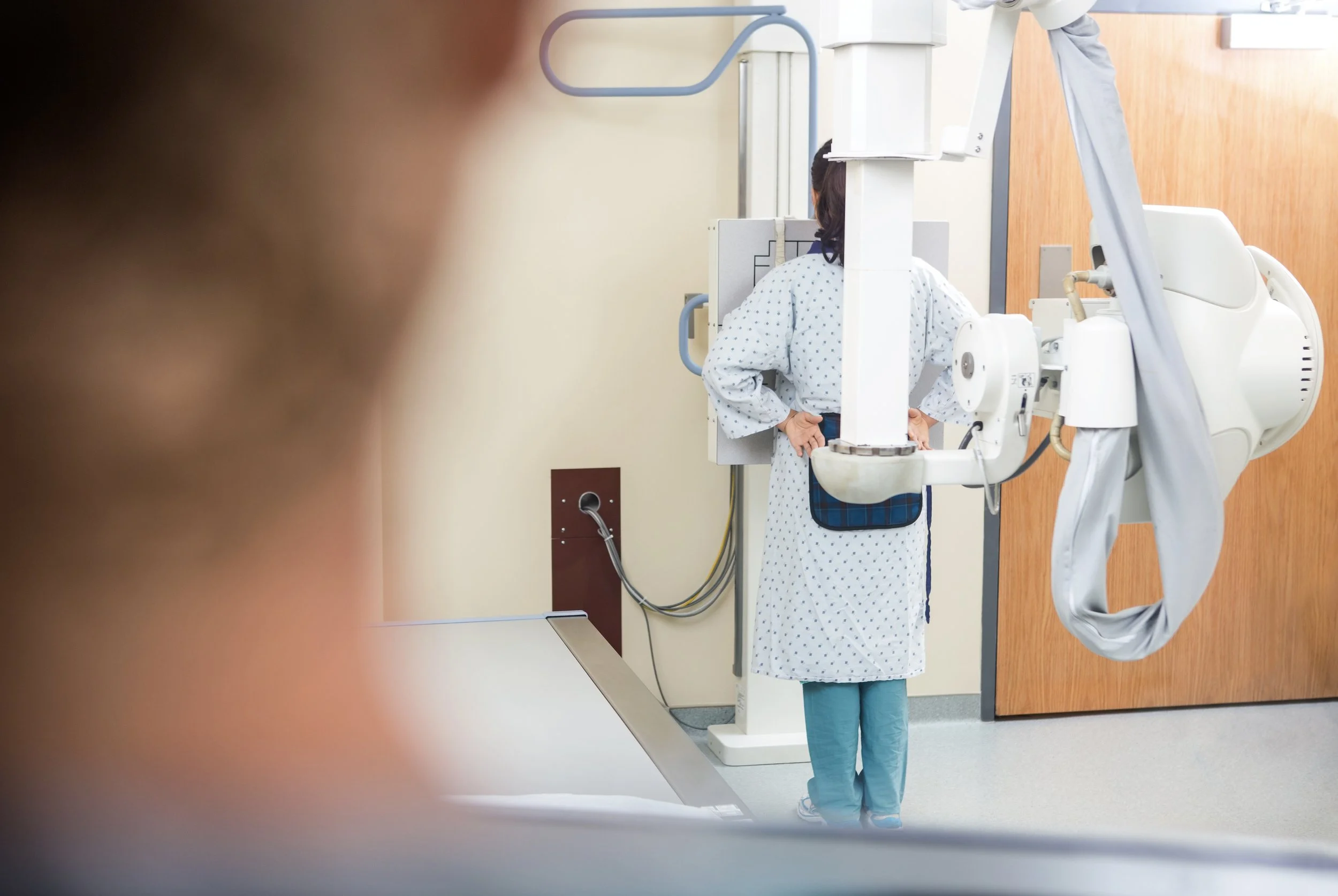
For most people, lung cancer is first seen on a chest X-ray or computed tomography (CT) scan, and the person who carries out that scan is usually a radiographer. On World Radiography Day, 8 November, we look at the part radiographers play in finding lung cancer earlier, from everyday X-rays to the screening programmes now being set up across Europe.
We also look at what a new European survey of more than 1,500 radiographers says about their changing role, what a major UK trial found about artificial intelligence (AI) and chest X-rays, and what is needed so that faster imaging leads to faster diagnosis.
Key points
Radiographers are often the only health professional with a person during their scan. In a new European survey, 64.0% said this was true of their work.
Lung cancer screening across Europe depends on a trained imaging workforce. Only 4 of 14 European countries in a recent study had established lung cancer screening training programmes.
AI can speed up X-ray reporting, but that alone does not speed up diagnosis. In the LungIMPACT trial of 93,326 chest X-rays, reports came back faster but the time to CT stayed at 53 days.
Radiographers want to develop their role. Over half (51.9%) think AI will strengthen it, but only 43.3% feel they have enough chances to progress.
In this article
What do radiographers do in lung cancer care?
Radiographers carry out the X-rays and CT scans used to find lung cancer, and they are responsible for getting a clear, safe image first time. They choose the right scanning protocol, position the person, keep the radiation dose as low as possible and check that the images can be read.
They are also the person someone meets at an anxious moment. A chest X-ray for a cough that will not clear, or a CT scan to check a shadow, can be the first sign that something is wrong. In some countries, including the UK, experienced radiographers also report chest X-rays, run lung cancer screening scans and help to manage follow-up scans for lung nodules.
World Radiography Day marks the anniversary of Wilhelm Röntgen's discovery of X-rays on 8 November 1895. It is led internationally by the International Society of Radiographers and Radiological Technologists and recognises the work of radiographers in diagnostic imaging and radiotherapy.
If you want to know what happens after a scan finds something, our explainer on how doctors find and remove tiny lung nodules follows the steps from scan to surgery.
Radiographers and lung cancer screening in Europe
Lung cancer screening with low-dose CT is spreading across Europe, and every programme needs radiographers to run it. Screening finds lung cancer at an earlier stage, when more treatment options are available, and an international review from the World Health Organization's cancer agency, the International Agency for Research on Cancer (IARC), has confirmed that it saves lives. We covered that review in Lung cancer screening saves lives: a new IARC review confirms it.
Countries are at very different stages. Germany launched its national programme in April 2026, while many others still run regional or pilot schemes. The new EU-funded SOLACE+ project, which began on 1 November 2026, will support 19 countries over three years to set up and improve screening, including staff training.
Training is a real gap. A study from the earlier SOLACE project, published in Insights into Imaging in July 2026, interviewed 25 screening experts from 14 European countries. Only 4 of the 14 countries had established lung cancer screening training programmes, and only France and the UK had mandatory training. The authors called for shared core curricula and minimum competency standards across Europe.
Can AI speed up lung cancer diagnosis from chest X-rays?
AI can help radiology teams report chest X-rays faster, but a large UK trial found that this alone did not shorten the time to a lung cancer diagnosis. The delays came after the scan.
The LungIMPACT trial, published in Nature Medicine in March 2026, tested AI that flagged chest X-rays suggestive of lung cancer and moved them up the reporting queue. It ran across five National Health Service (NHS) trusts in England and included 93,326 chest X-rays requested by general practitioners. The principal investigator was Nick Woznitza, a consultant radiographer at University College London Hospitals.
LungIMPACT trial results
Median time to report the X-ray: 47 hours without AI prioritisation, 34 hours with it
Median time from X-ray to CT scan: 53 days in both groups
Source: LungIMPACT randomised controlled trial, five NHS trusts in England, 93,326 chest X-rays, Nature Medicine, March 2026.
The researchers found the hold-ups were in what followed: telling the person, booking the CT scan and arranging clinic appointments. As Nick Woznitza put it, "The bottleneck isn't the reporting; it's everything that happens next."
This supports a point Lung Cancer Europe has made in our work on rapid referral pathways: new technology only helps people if the whole pathway is organised to act on it. Our position statement on AI in lung cancer care sets out how AI should be introduced, and our article on AI that reads lung scans the way a radiologist does looks at where the technology is heading.
Radiotherapy for lung cancer: the work of therapeutic radiographers
World Radiography Day also recognises therapeutic radiographers, who plan and deliver radiotherapy. Radiotherapy is used to treat lung cancer at every stage, not only to ease symptoms.
For people with small, early-stage lung cancer who cannot have surgery, or choose not to, stereotactic ablative radiotherapy (SABR) is a curative treatment. It delivers very high, precisely targeted doses in a small number of sessions, typically fewer than five, and is often considered the standard treatment for this group. Drew Moghanaki, a radiation oncologist at the University of California, Los Angeles (UCLA) and the US Department of Veterans Affairs, and co-chair of the VALOR trial,, put it this way: "With sub-millimeter accuracy, we now treat and even cure lung cancer in a single session."
Whether SABR works as well as surgery for people who are fit for either is still being tested. The VALOR trial in the US plans to compare survival after five years in 670 people. Its results are not yet available.
New evidence suggests radiotherapy may also help when lung cancer has spread to a small number of places. In the UK SARON trial, presented at the European Society for Medical Oncology (ESMO) Congress in October 2026, 140 people with non-small cell lung cancer that had spread to between one and five sites received standard drug treatment, with or without high-dose radiotherapy to every known site. Adding radiotherapy extended median progression-free survival from 8.9 to 13.9 months, without affecting quality of life. Overall survival was similar in both groups, at 31 and 28 months, so the main benefit was keeping the cancer under control for longer.
What a new European survey says about radiographers
A survey of 1,548 radiographers, published in Insights into Imaging on 30 October 2026, shows a profession taking on more responsibility and ready to do more. It was run by the European Network for the Assessment of Imaging in Medicine (EuroAIM) and the European Federation of Radiographer Societies (EFRS). Almost all respondents (97.4%) work in Europe, and nearly half (48.3%) work in the UK.
What radiographers said
85.8% see themselves as most responsible for optimising image quality
84.8% find continuing professional development courses useful
84.0% see themselves as most responsible for radiation protection of the person being scanned
66.0% work independently of doctors in their daily tasks
64.0% are often the only health professional in contact with the person during the examination
57.4% would choose radiography again
51.9% think AI will strengthen their role
43.3% feel they have enough career progression opportunities
Source: Cornacchione P, et al. EuroAIM/EFRS survey, Insights into Imaging 2026;17:271. Survey run July to September 2025.
The authors describe "a profession in transition, characterised by increasing responsibilities". They call for structured, internationally comparable career frameworks, targeted AI education and more investment in research led by radiographers, so that radiographers are supported as autonomous professionals rather than only as technical operators. Career paths vary: the UK has a four-tier structure that includes advanced and consultant practitioners, and more established frameworks than many other European countries.
The survey has limits. It was in English, shared through professional and academic networks, and UK radiographers make up almost half of the responses, so it may not reflect every country equally.
Find out more: Lung Cancer Europe's Get Checked! campaign helps member organisations raise awareness of lung cancer symptoms and early diagnosis across Europe.
What needs to change
Earlier diagnosis of lung cancer depends on a skilled imaging workforce and a pathway that moves quickly once a scan raises concern. The evidence above points to three priorities.
Train and grow the screening workforce. As screening expands through national programmes and projects such as SOLACE+, Europe needs common training standards for everyone involved, including radiographers.
Fix the steps after the scan. LungIMPACT shows that faster reporting does not help unless CT scans, results and clinic appointments follow quickly. Timed targets and rapid referral pathways can close that gap.
Introduce AI with the workforce, not around it. Radiographers broadly expect AI to strengthen their role. They need training and clear responsibilities so AI supports, rather than replaces, professional judgement.
These priorities match the call in our Charter 2026 to 2030 for fast, high-quality diagnosis for everyone affected by lung cancer, wherever they live in Europe.
Frequently asked questions
What is World Radiography Day?
World Radiography Day is held every year on 8 November, the anniversary of Wilhelm Röntgen's discovery of X-rays in 1895. It recognises the work of radiographers in diagnostic imaging and radiotherapy, and raises awareness of their role in healthcare.
What is the difference between a radiographer and a radiologist?
A radiographer is a health professional who carries out imaging such as X-rays and CT scans, or delivers radiotherapy. A radiologist is a doctor who specialises in interpreting scans. In some countries, specially trained radiographers also report certain scans, including chest X-rays.
Do radiographers take part in lung cancer screening?
Yes. Lung cancer screening uses low-dose CT scans, and radiographers carry out these scans and make sure the radiation dose is kept low. As screening programmes expand across Europe, training standards for the screening workforce are still uneven between countries.
Does AI make lung cancer diagnosis faster?
Not on its own. In the UK LungIMPACT trial, AI helped radiology teams report chest X-rays faster, but the median time from X-ray to CT scan stayed at 53 days. The delays were in the steps after the scan, such as booking CT scans and appointments.
Can radiotherapy cure lung cancer?
For some people, yes. Stereotactic ablative radiotherapy (SABR) is a curative treatment for small, early-stage lung cancers in people who cannot have surgery or choose not to. When lung cancer has spread, radiotherapy is mainly used to control the cancer and ease symptoms, and trials such as SARON are testing how it can keep the cancer under control for longer.
Summary
Radiographers are at the start of most people's lung cancer diagnosis, and their role is growing as screening expands and AI enters everyday practice. A new survey of 1,548 radiographers shows a profession taking on more responsibility, while the LungIMPACT trial shows that faster imaging only helps when the rest of the pathway keeps up. On World Radiography Day, Lung Cancer Europe thanks radiographers across Europe and calls for investment in the imaging workforce and in fast, joined-up diagnostic pathways.
Read more: explore our policy and resources, including our work on rapid referral pathways and AI in lung cancer care.
About Lung Cancer Europe
Lung Cancer Europe is a pan-European advocacy organisation working for equal access to high-quality lung cancer care across Europe. Our members are national lung cancer advocacy organisations, and we bring their evidence and experience to European policymakers. Through our annual Lung Cancer Europe Reports, our Charter and the Get Checked! campaign, we work to improve diagnosis, treatment and support for everyone affected by lung cancer.
References
Cornacchione P, Zanardo M, Malamateniou C, Precht H, Knight KJ, Sardanelli F, Knapp K. The evolution of radiographers: an investigation into radiographers' role and perspectives: a EuroAIM/EFRS survey. Insights into Imaging. 2026;17:271. Open access
University College London Hospitals NHS Foundation Trust. AI-driven technology does not speed up lung cancer diagnosis. 24 March 2026. UCLH news (LungIMPACT trial, Nature Medicine, 2026)
Tschabuschnig C. Lung cancer screening training gaps across Europe. AuntMinnieEurope, 3 August 2026. Article (reporting Mura R, et al., Insights into Imaging, July 2026)
International Society of Radiographers and Radiological Technologists. World Radiography Day
Lung Cancer Europe. SOLACE+ launches to expand lung cancer screening across Europe. November 2026.
Buchberger DS, et al. The treatment of patients with early-stage non-small cell lung cancer who are not candidates or decline surgical resection: the role of radiation and image-guided thermal ablation. Journal of Clinical Medicine. December 2024. Article
PharmaTimes. Radiotherapy boosts progression-free survival in advanced lung cancer (SARON trial, ESMO Congress 2026). 28 October 2026. Article
OncoDaily. Drew Moghanaki: SBRT has forever changed lung cancer treatment. 2 January 2025. Article
UCLA Health. Veterans lung cancer treatment study is largest ever (VALOR trial). Article